Technical information: How does our mathematical model work?
IMPORTANT:
We make available to the client a Spanish translation of this Technical Information (‘Información técnica’). You can consult it at this link.
In any legal dispute, this Technical Information in English shall prevail over the Spanish translation.
This Disclaimer of Responsibility and all matters arising hereunder are subject to U.S. law and the exclusive jurisdiction of the courts of the United States of America.
The Co-Path Investment model epitomizes the fusion of mathematical expertise, computational sophistication and financial knowledge within the forex trading sphere. Developed through extensive research, continuous refinement and rigorous testing, this model represents an intricate amalgamation of advanced mathematical concepts, statistical methodologies and state-of-the-art computational algorithms meticulously designed to unravel the complexities of the foreign exchange market landscape.
At its core, the Co-Path Investment model is based on a solid foundation of mathematical theory and quantitative analysis, leveraging a wide range of mathematical frameworks and statistical techniques to extract actionable insights from a vast reservoir of real-time and historical market data. From stochastic calculus and time series analysis to machine learning and artificial intelligence, the model employs a multidisciplinary approach to deciphering the multifaceted dynamics of foreign exchange rates.
To elucidate the technical aspects of the Co-Path Investment model in the context of the Forex market, it is crucial to delve into the various mathematical methodologies and computational algorithms that comprise its framework:
Stochastic calculation and market dynamics: for example, consider the EUR/USD currency pair. Stochastic calculation allows the Co-Path Investment model to model EUR/USD price movements as a stochastic process, incorporating factors such as interest rate differentials, economic indicators and geopolitical events into the model. By simulating thousands of possible price paths using stochastic differential equations, the model can forecast future price movements and assess the likelihood of various market scenarios.
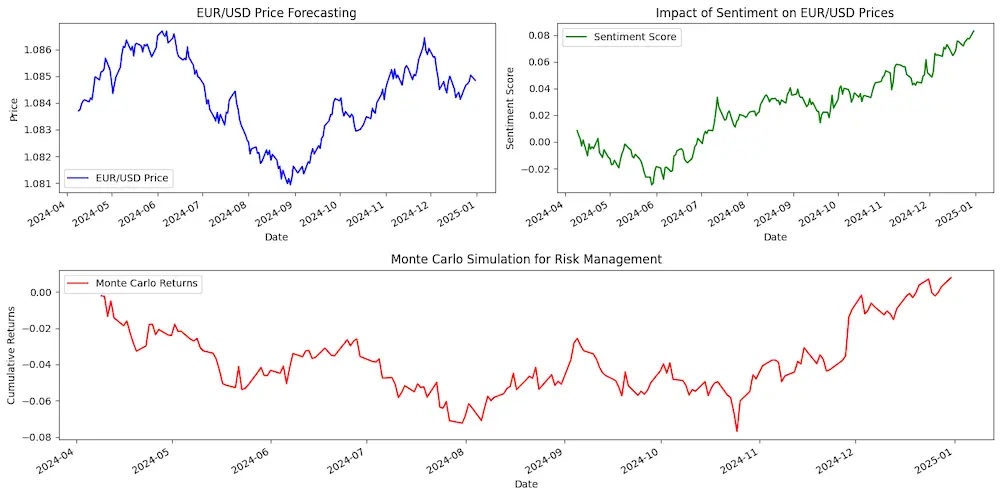
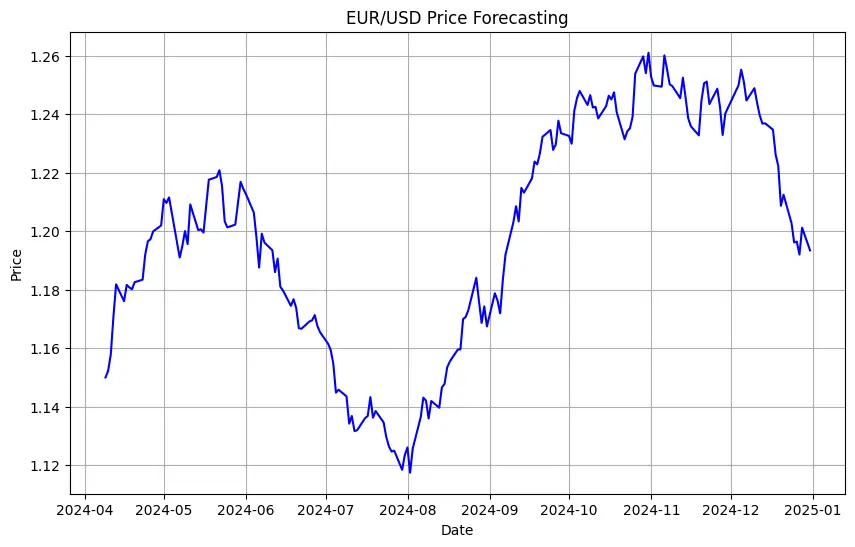
Time series analysis and price forecasting: Using historical EUR/USD price data, the Co-Path Investment model applies time series analysis techniques such as ARIMA modeling to identify trends, seasonality and cyclical patterns in currency prices. By fitting an ARIMA model to historical price data, the model can generate forecasts of future EUR/USD exchange rates, allowing traders to anticipate market trends and make informed trading decisions.
Machine learning and sentiment analysis: for example, suppose there is a sudden increase in positive sentiment towards the euro in social media discussions and news articles. The Co-Path Investment model, which leverages machine learning algorithms, can analyze this unstructured data to measure market sentiment and assess its impact on EUR/USD prices. By incorporating sentiment analysis techniques, the model can identify emerging trends and adjust its trading strategies accordingly, maximizing returns in response to changing market sentiment.
Optimization and portfolio management: Consider a portfolio comprising multiple currency pairs, including EUR/USD, GBP/USD and USD/JPY. Using optimization techniques such as mean-variance optimization, the Co-Path Investment model can allocate capital across these currency pairs to maximize risk-adjusted returns. By formulating the portfolio allocation problem as a mathematical optimization problem and incorporating constraints such as risk tolerance and correlation coefficients, the model identifies the optimal combination of currency positions that balances risk and return, thereby improving portfolio performance.
Risk management and Monte Carlo simulation: Suppose the Co-Path Investment model identifies a potential market shock that could affect currency prices. Using Monte Carlo simulation techniques, the model simulates thousands of possible market scenarios, assessing the potential impact of the shock on portfolio returns. By quantifying the probability of various risk factors and analyzing the distribution of potential outcomes, the model allows traders to implement effective risk management strategies, such as adjusting position sizes or implementing hedging techniques, to mitigate downside risk and preserve capital.
Algorithmic trading and high-frequency strategies: In a high-frequency trading scenario, where milliseconds can make all the difference, the Co-Path Investment model uses algorithmic trading strategies to execute trades accurately and efficiently. By leveraging execution algorithms and low-latency trading infrastructure, the model can capitalize on short-term market inefficiencies and exploit fleeting opportunities in the FX market, maximizing profitability and reducing execution costs.
By integrating these advanced mathematical techniques and computational algorithms, the Co-Path Investment model enables traders to navigate the complexities of the foreign exchange market with confidence and precision, allowing them to capitalize on emerging trends, manage risk effectively and achieve consistent returns over time. As financial markets continue to evolve and innovate, the Co-Path Investment model remains at the forefront of quantitative trading, pushing the boundaries of mathematical finance and delivering superior returns for its clients in the dynamic and ever-changing landscape of the foreign exchange market.